
Theatre Programmes (UK & Ireland)
Print Production & Design Systems
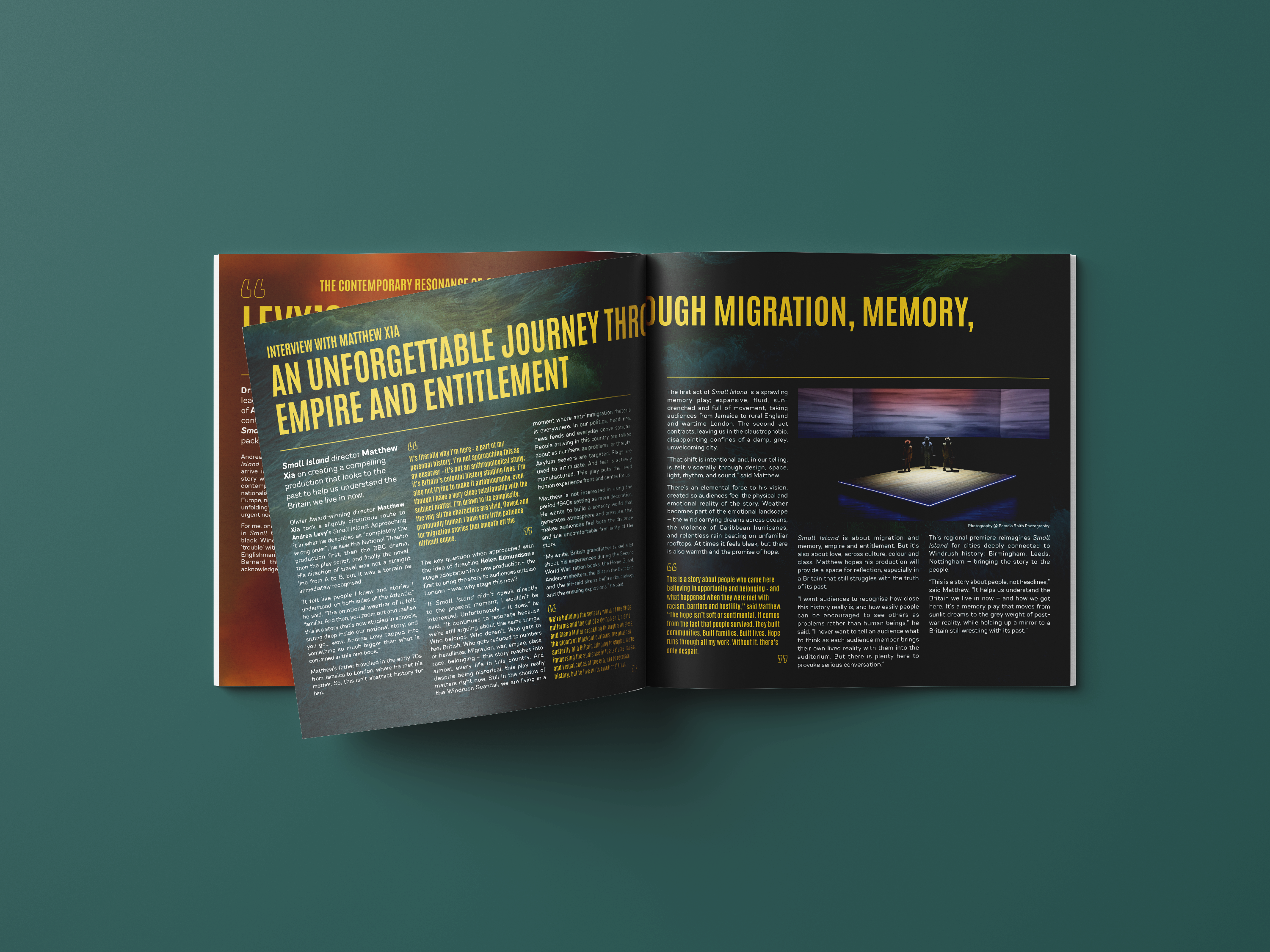
From one programme a month to five.
I design the theatre programmes for the venues and shows we work with: covers, cast and creative bios, “What’s On” pages, sponsor and credits sections, the lot. I started doing this in 2023, and it’s carried straight through into my current role. It’s the work I do most often, and honestly one of my favourites, and there’s always some new edge case to design around.
Every programme started from scratch.
When I started, every programme was built from a blank InDesign document. Text was formatted manually: italics and bold applied by hand, headings styled one at a time, cast and creative bios laid out individually for each show. Headshots were placed as loose images rather than tied to their text, so if a bio moved, the photo didn’t move with it.
None of this was wrong, exactly, but it just meant a huge share of the time on each programme went on formatting and fixing layout issues rather than on the actual design. A show with a large cast could mean dozens of bios to lay out by hand, each one a chance for something to drift out of place.
Designing a system, not another document.
Rather than keep solving the same formatting problems show after show, I built a proper system for the whole production:
- Paragraph and character styles for every recurring text element (headings, bio copy, credits, “What’s On” listings), so formatting became a one-click application instead of manual styling.
- Nested styles to handle the recurring patterns within bios (name in bold, role in italics, body copy plain) automatically.
- Anchored images for cast and creative headshots, so each photo is tied to its bio and moves with the text rather than sitting on top of it.
- A reusable template for cast and creative spreads, so a new show’s programme starts from a structure that already works rather than a blank page.
The impact.
The system changed what a programme turnaround looks like. What used to be roughly one programme a month became five a month at the same level of quality, and the time spent on formatting and corrections dropped by around half, because most of it is now handled by the styles and template rather than by hand.
It also means the work is consistent regardless of how tight the turnaround is: a programme built under deadline pressure looks the same as one with weeks of lead time, because the structure is already there.
What this project demonstrates.
Systems thinking applied to production work: identifying that the bottleneck wasn’t design skill but repeated manual setup, then building a system to remove it.
Process design with measurable impact: a 5x increase in output and roughly 50% less time on formatting, achieved by changing the workflow rather than working faster.
Ownership of a recurring deliverable: this is the project I’ve done longest and most often, and the one where I’ve had the most room to improve how the work gets done, not just what it looks like.
It’s also the project that’s taught me the most about where good process actually pays off, and I’m always looking for the next thing to streamline.