
Centre for Sustainable Innovation
Website Rebuild

Taking an existing template and making it CSI’s own.
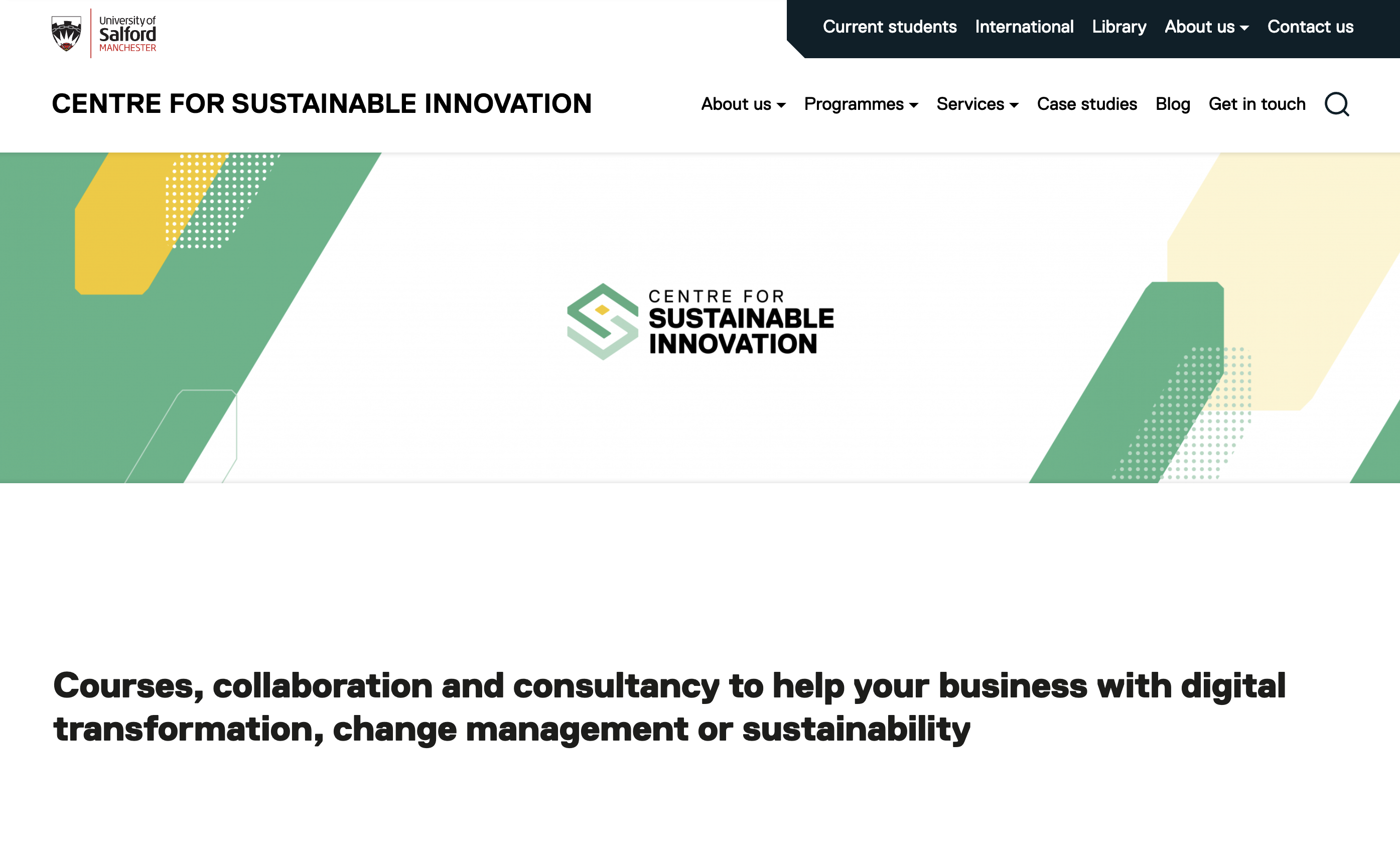
As Marketing Officer for the Centre for Sustainable Innovation (CSI) at the University of Salford, I took on rebuilding the CSI website within the University’s WordPress subsite template, restructuring the content, redesigning the graphics, and applying a refreshed brand identity to turn a generic template into something that felt distinctly CSI.
A centre with a constantly changing roster.
CSI delivers a rotating set of funded business-support programmes for Greater Manchester SMEs, including Innovation Labs, the Help to Grow: Management Course, Know Digital, the Five-C Network, and others that come and go as funding cycles shift. The old site squeezed all of this onto a handful of pages with no clear structure, making it hard for funders, partners, and participants to find what applied to them.
Working within the template, not around it.
The University of Salford’s WordPress theme came with a fixed page structure and component library: I didn’t have the freedom to build from scratch, but I could use what was there far more deliberately than the existing site did.
From there, I made three changes:
- Restructured the information architecture: Services, Programmes, Research & Initiatives, the Affiliate Zone, and Case Studies each got a proper home, instead of being squeezed onto a single page.
- Redesigned every graphic and image: banners, icons, and supporting visuals across the new structure, all rebuilt to a consistent style within the template’s components.
- Applied CSI’s brand identity throughout: colour, typography, and imagery carried through every page, so the site reads as CSI’s own rather than a generic University subsite.
I’m really pleased with how it turned out: it’s live at sustainable-innovation.salford.ac.uk, shown here as it stood as of December 2025.
What this project demonstrates.
Working within constraints: Taking an existing template and component set and using it to its full potential, rather than treating it as a limitation.
Content strategy and IA: Restructuring a growing, rotating portfolio of programmes into a site structure that scales without becoming unwieldy.
Brand applied to web: Carrying a brand identity through an existing system consistently enough that the end result reads as a distinct, owned site.
Working within someone else’s constraints turned out to be one of the most useful design exercises I’ve done: it pushed me to find good solutions inside a tighter box than I’d choose myself.